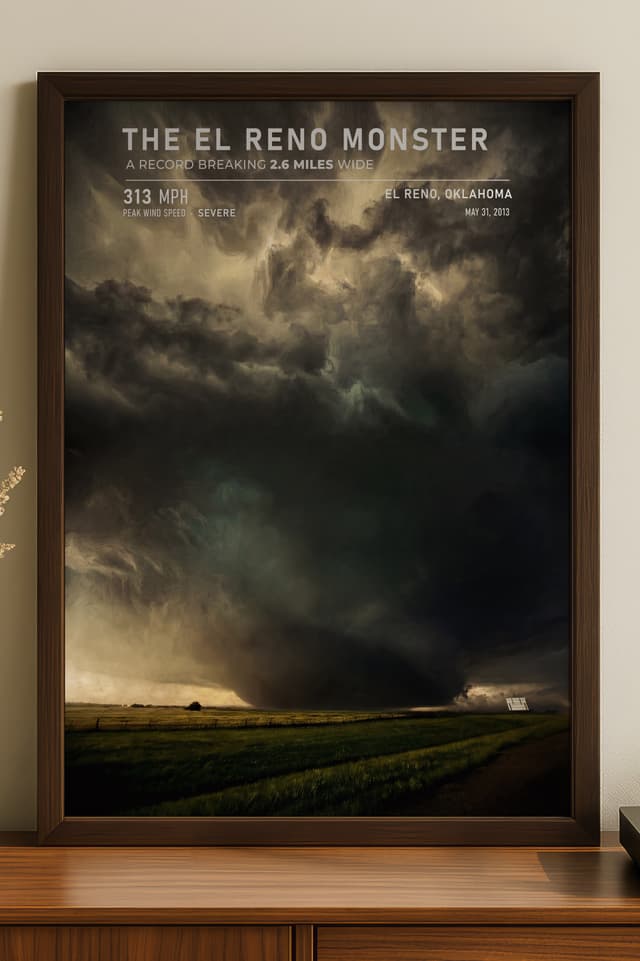
The El Reno Tornado, 2013
On May 31st, 2013, a tornado formed near El Reno, Oklahoma that reached a maximum width of 2.6 miles, making it the widest tornado ever recorded. It was officially rated EF3 based on structural damage. Mobile Doppler radar measured wind speeds within the tornado that likely exceeded 300 mph. Eight people died, including three professional storm chasers: Tim Samaras, his son Paul Samaras, and their colleague Carl Young. The facts of this event need to be stated plainly from the start, because they shape everything about how it should be discussed.
The Meteorological Setup
The southern Great Plains were primed for severe weather on May 31st. The Storm Prediction Center had issued a high risk for the area, forecasting significant tornado potential across central Oklahoma. Chasers and forecasters expected intense supercell thunderstorms and violent tornadoes.
This was not an event that caught the community by surprise in terms of the atmospheric setup. The instability, shear, and moisture were all in place for a major severe weather day. What was unexpected was the specific behaviour of the tornado that developed near El Reno.
The Tornado
The El Reno tornado formed during the mid-afternoon from a supercell thunderstorm southwest of El Reno. It grew rapidly in size, reaching its maximum width of 2.6 miles at peak intensity. To contextualise that width: 2.6 miles means the tornado's circulation extended across a distance greater than the length of most small towns. The visual scale was difficult to comprehend even for experienced chasers who had witnessed hundreds of tornadoes.
The tornado's movement was highly erratic. Most tornadoes follow a reasonably predictable path based on the motion of their parent thunderstorm. The El Reno tornado made multiple significant direction changes, including a sharp turn that brought it into areas where storm chasers had positioned based on expected storm motion. This erratic behaviour made the tornado extraordinarily dangerous to intercept because traditional positioning strategies assumed a degree of path predictability that this storm did not provide.
The internal structure was complex. Multiple sub-vortices rotated within the main circulation, each capable of producing extreme winds. Mobile Doppler radar deployed in the area measured winds that far exceeded the EF3 damage rating the tornado would eventually receive.
The Rating Problem
The El Reno tornado is one of the most discussed anomalies in modern tornado science. Its official EF3 rating is based on the damage it caused to structures within its path. The Enhanced Fujita Scale rates tornadoes by what they destroy, not by direct wind measurement.
The problem is that the El Reno tornado spent most of its time over open rural terrain. There were relatively few structures in the path for it to damage. The structures that were hit sustained EF3-level damage, so EF3 is the official rating.
Meanwhile, the University of Oklahoma's mobile Doppler radar unit measured wind speeds within the tornado's sub-vortices that likely exceeded 300 mph. That would place the actual wind speeds well into EF5 territory. The gap between the official rating and the measured winds exists because the scale measures effect rather than cause. A tornado that passes over empty fields cannot be rated by structures that are not there.
This is a fundamental limitation of damage-based rating systems, and El Reno is the clearest illustration of why the official rating of a tornado does not always reflect its true intensity.
Tim Samaras and the TWISTEX Team
Tim Samaras was an engineer and storm researcher who founded TWISTEX, the Tactical Weather Instrumented Sampling in Tornadoes Experiment. His work focused on placing instrumented probes directly in the paths of tornadoes to collect pressure, temperature, humidity, and wind data from inside the vortex. He successfully deployed probes in the path of an F4 tornado near Manchester, South Dakota, in 2003, recording the largest pressure drop ever measured inside a tornado.
Samaras was not an amateur. He was one of the most experienced and methodical field researchers in the storm chasing community. His safety record prior to El Reno was exemplary. The TWISTEX team operated with deliberate caution and well-defined safety protocols.
On May 31st, the TWISTEX team was caught by the tornado's erratic path changes. Tim Samaras, his son Paul, and colleague Carl Young were killed when their vehicle was struck by the tornado after it made an unexpected change in direction. Their deaths were a direct consequence of the tornado behaving in ways that even the most experienced operators could not anticipate.
The loss affected the storm chasing community deeply. Samaras was respected not just for his scientific contributions but for the degree of care he brought to field work. That an operator of his calibre was caught by this tornado says something specific about how unusual its behaviour was.
What Changed
The deaths of the TWISTEX team, along with the broader dangers exposed by the El Reno event, prompted significant discussion within the storm chasing community about safety practices, intercept risk, and the limits of what can be safely approached.
El Reno demonstrated that certain tornadoes can behave in ways that invalidate standard positioning assumptions. A tornado that changes direction rapidly, expands to 2.6 miles wide, and moves erratically across the landscape does not allow for the safe positioning margins that chasers typically rely on. The consensus that emerged was not that chasing is inherently too dangerous, but that certain storms present risks that cannot be managed through experience alone.
The event also reinforced the importance of real-time awareness. Radar data, GPS tracking, and communication among chasers in the field became even more emphasised as essential tools for assessing when a storm is behaving outside normal parameters.
There is a tension at the centre of storm chasing that El Reno made explicit. The desire to understand severe weather requires proximity to severe weather. The cost of that proximity, on the worst days, is real. That tension does not resolve neatly, and the community does not pretend it does.
We have a graphic of the infamous El Reno Monster. It is in the shop.